Community First
Students begin with real needs rather than predetermined business ideas.

A community-centered entrepreneurship framework
Beyond the Diploma challenges students to identify unmet community needs, investigate real opportunities, test assumptions, and develop evidence-based business concepts they can carry into entrepreneurship, the workforce, continued education, and other pathways beyond high school.
Why Beyond the Diploma?
Artificial intelligence will continue to reshape the workforce landscape in the coming years, changing how people work, the skills employers value, and the opportunities available to students after high school. At the same time, not every student will choose a traditional college or trade-school pathway.
Beyond the Diploma introduces students to entrepreneurship through a different lens. Rather than beginning with the question, “What business do you want to start?” students begin by observing their communities, identifying unmet needs, and investigating whether those needs represent real opportunities.
The goal is not simply to produce a business plan or encourage every student to become an entrepreneur. It is to help students recognize opportunity, investigate demand, use evidence, make informed financial and business decisions, communicate ideas, and adapt when assumptions are challenged. In doing so, students develop practical, transferable capabilities they can carry into entrepreneurship, the workforce, continued education, and other pathways beyond high school.
Students begin with real needs rather than predetermined business ideas.
Students investigate demand, customers, competition, resources, and feasibility before committing to an idea.
Students learn that changing direction is not failure. Evidence may lead them to proceed, modify, or pivot.
The Beyond the Diploma Framework
Modules represent phases of learning, not a prescribed timetable. Schools can adapt the pacing to their schedule while preserving the entrepreneurial process.
Students observe their community, talk with people, examine local conditions, and identify unmet or underserved needs worth investigating.
Students research the problem, identify potential customers or users, examine existing solutions, and begin gathering real-world evidence.
Students develop an initial Lean Canvas, identify key assumptions, consider customers, value propositions, costs and revenue possibilities, and determine what must be tested.
Students compare assumptions with what they learned, decide whether to proceed, modify, or pivot, and revise the business model accordingly.
PROCEED ↔ MODIFY ↔ PIVOT
Students examine operations, pricing, financial feasibility, marketing, resources, partnerships, and how the concept could realistically function.
Students develop a final evidence-based proposal and communicate why the opportunity is viable—or explain why the evidence led them in another direction.
The Community Becomes the Classroom
Students engage with their community, explore local needs, and connect learning to real-world opportunities.
City Hall • Local priorities • Civic insight
Students gain context for community priorities, public needs, planning, and the local conditions that can influence opportunity.
Chamber of Commerce • SBA partners • Community support
Students encounter the organizations and support ecosystem available to entrepreneurs beyond the classroom.
Business owners • Experience • Challenges
Students hear directly about demand, operations, financing, risk, mistakes, resilience, and adaptation.
AI-Supported Planning
Students may use generative AI to assist with brainstorming, research planning, customer-discovery preparation, business-model development, financial scenario exploration, marketing and communication planning, project organization, and pitch preparation.
AI can help you plan, organize, question, and brainstorm. It cannot replace evidence.
AI output is not customer discovery.
AI output is not community input.
AI output is not market validation.
Consequential information must be verified through credible sources and real-world evidence.
What Students Take Beyond the Diploma
Interviewing, questioning, presenting, and pitching.
Understanding how economic opportunity connects to local needs.
Seeing needs and possibilities others may overlook.
Responding constructively when evidence challenges the original idea.
Thinking critically about pricing, costs, revenue, and feasibility.
Distinguishing assumptions from verified information.
Adaptable by Design
Different communities may reveal needs related to food access, transportation, childcare, youth activities, essential services, technology, agriculture, tourism, neighborhood retail, or other locally identified opportunities. The process stays consistent while the opportunity changes with the community.
Designed to align with the 2023 National Standards for Business Education in Entrepreneurship, published by the National Business Education Association (NBEA).
Beyond the Diploma is an independently developed educational framework and is not presented as approved, certified, or endorsed by NBEA.Sample Learning Experience
Essential Question: What does our community need?
Students begin by looking outward rather than starting with a predetermined business idea. They observe their community, listen to others, and identify unmet or underserved needs that may be worth investigating.
Students explore their community through observation, conversation, and research. They look for patterns, recurring challenges, service gaps, and needs that affect individuals, families, organizations, or businesses.
Students may engage with local leaders, community organizations, business owners, residents, or other stakeholders to better understand the local context.
The goal at this stage is not to decide on a business. It is to learn enough about the community to identify needs worth exploring.
Generative AI can help students develop observation questions, organize notes and emerging themes, brainstorm questions for community conversations, identify information that still needs verification, and prepare for the next stage of research.
AI can help students think and organize. It cannot determine whether a community need actually exists.
Before moving forward, students ask:
What do we know?
What are we assuming?
What still needs to be verified?
Student Deliverable
Students identify two to three community needs that appear worthy of further investigation and briefly explain what the need is, who may be affected, what evidence currently supports it, and what questions still need to be answered.
What Happens Next?
One promising need moves forward. Students begin gathering stronger evidence about demand, potential customers or users, existing solutions, and whether the identified need could represent a viable opportunity.
Explore Beyond the Diploma
Explore public-facing resources that explain the philosophy, structure, and community-centered approach behind Beyond the Diploma. Detailed curriculum-planning materials, teacher implementation tools, assessments, and lesson resources remain part of the protected instructional framework and are not published here.
A concise introduction to the instructional reasoning, framework progression, and core design principles of Beyond the Diploma.
Resource link coming soonA visual introduction to identifying community needs, investigating opportunities, and connecting entrepreneurship to economic possibility.
Resource link coming soonUse this site to understand the public-facing structure and philosophy of Beyond the Diploma.
View framework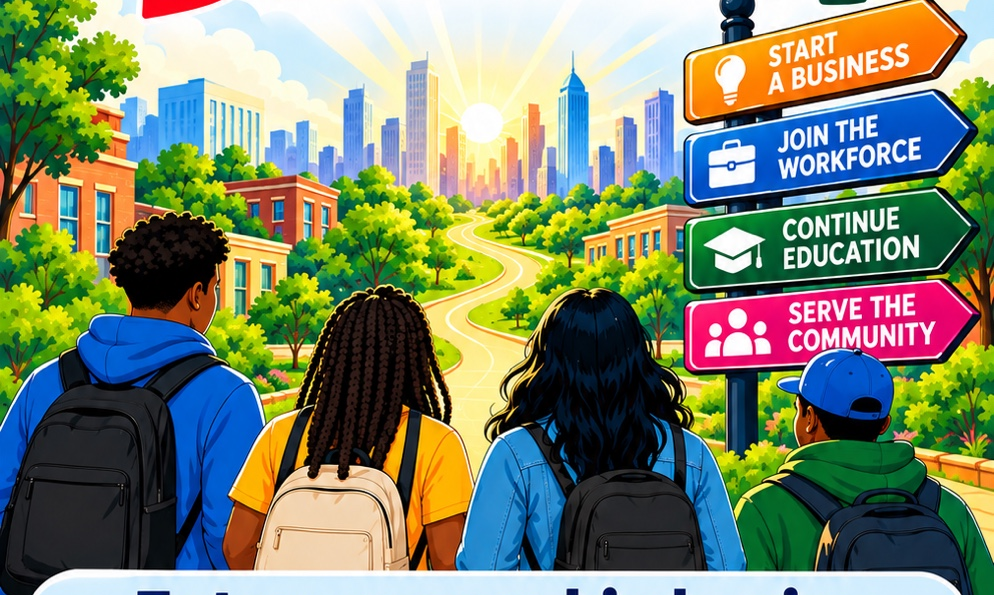
Beyond the Diploma
Beyond the Diploma challenges students to identify unmet community needs, investigate opportunities, and use evidence to determine whether an idea can become a viable income-generating opportunity.
Sonya Foster
Creator, Beyond the Diploma
Beyond the Diploma is an independently developed educational framework created and presented by Sonya Foster.
CONNECT
For more information about the framework, educator resources, collaboration opportunities, or future implementation support, please contact:
Sonya Foster
Creator, Beyond the Diploma